一等于零
OneIsZero

ONE IS ZERO
FOREWORD
IN PHILOSOPHY WE TRUST
As the complexity and chaos of life presents us with endless questions and thus the search for meaning, we are presented with attempted answers from religions, and cultures. Ultimately it is not about answerers, it is about how you approach those questions and arrive at an answerless state. In many occasions, answers serve as nothing but bondages. Bondaages may provide certainty, but at what cost? Christianity, Buddhism, Taoism and psychoanalysis are each sharing one single word from the book of Truth while whole chapters remain undisclosed.
Figuratively, we are presented with one photograph of an elephant. This is not to say that the great thinkers heretofore are like ‘the blind men’ in the blind men elephant parable. Indeed they are wise and enlightened, but viewed in isolation, we cannot understand the true shape of the elephant, its scale, texture and character if our understanding is based on the one photograph alone, however beautiful and well framed it may be.
Only philosophy is capable of the task of pulling everything together seamlessly, largely because of the fact that philosophy is a science free from bias and narcissism - most especially collective narcissism. Unlike religions, philosophy is free from the burden of proving that ‘my philosophy is the best philosophy’.
Philosophy is also unlimited in every aspect. No one can set a boundary marking down how far philosophy can go. If we have to cover up the Empire of the Borges fable with a map anyway, let philosophy do the job, other than conceptuality.
This book is dedicated to a new thinking --- a common philosophy can be extracted from Christianity, Buddhism, Taoism and science to be the core of spirituality and existence of life. Philosophy is on the level of knowing, while religion is generally understood as on the level of believing, thus philosophy can be closer to the core of existence.
It can be summarized as fusion of the opposites.We need both opposites to wave, to vibrate. It can be the ultimate form of existence. The vibration is the ultimate dance between the opposites of everythingness and nothingness, ego and egolessness, language and silence, form and emptiness, individualism and collectivism, fear and fearlessness, certainty and uncertainty, sacred and secular, theism and atheism, real and unreal.

The fusion of the opposites can be expressed mathematically as:
1 = 0
Philosophy can be the one ring that rules all when we are freed from the burden of choice --- the choice among religions, the choice between religion and science, and the choice between the opposites.
Ultimate freedom has nothing to do with choice.
Spirituality is peace, transcending all differences between cultures and religions. Rebuilding the faith in God via philosophy to unite mankind can be the only way-out to avoid world war III, a war over resources and space for survival in a nuclear way.
This book was originally intended to be a short transcript of the first video on my YouTube

channel Free Ur Mind but has grown substantially into an overview of the theories that I am going to present. The topics and their associated theories discussed in this book will be explored by deeper discussions and analysis on the channel and more books down the road. The titles of my upcoming two books will be the Complications of Loving, and Chinese Culture 3000.
Fan Zou
CHAPTER I
LIFE AS CLOUD
I had the idea of writing a book and starting a YouTube channel for quite some time with the aim of sharing what I have seen, heard and thought about throughout my career in media and in law for the past years.
There are two events which began this journey of question and discovery. The first incident was more than 20 years ago when I worked at Wuhan TV station in Wuhan, China. I and my colleagues visited a famous Taoist priest at his home. This extraordinary meeting opened my eyes wide forever as it was an interaction with someone possessing actual psychic abilities. The Taoist priest had never been to my home, but it became apparent that he knew about the contents and layout just as he has been there and examined every corner. The priest then gave me suggestions on rearranging furniture and decorations in accordance with Feng Shui principles which of course, I followed!. I asked him at the time: “You can see all of this?” He replied that he could see everything. He said that every night when he meditates, his soul goes out for a tour.
In the later visits, the Taoist priest told us of many miraculous things, and of profound Zen and Taoist theories. He also recalled that a Russian missionary had once come to visit him, and that they both had the ability to see things invisible to other people. He said he saw a cross behind the Russian missionary, following him wherever he goes. The Russian missionary said he saw many symbols behind the Taoist priest.
I had numerous subsequent encounters with practitioners of Buddhism and Taoism, as I continued to meet more than 20 people with perceptive capabilities, insights into what they should not have been able to know and psychic abilities. Six of these were Buddhist abbots of temples, in both China and Canada. Those other than the abbots, they hide themselves in the daily crowd, doing insignificant jobs, not revealing their true power. Their spiritual realm is just as what Tao Te Ching says: The ancient Tao cultivators were subtle and mysterious. They were of immeasurable profundity, knowing the world without leaving their homes.
Another example of this perceptive clarity in the universes mysteries is Nicola Tesla, known as the scientist who invented the 20th century. The machines he invented didn’t need to be improved through experimentation, but were expressions of fully developed concepts and processes never seen before. Tesla possessed a deep understanding of complex scientific theories entirely new and mysterious to the worlds scientific community. He was able to contemplate new theories, prototype solely in his mind and build the final iteration to the amazement of all. In answering questions about his remarkable

achievements, he said there existed an information database in the center of the universe, which contains all knowledge. He needed only to connect to the database and retrieve the information from it. He said that his soul could travel to another planet, spend a few months with people there, and come back. He also said that every particle has consciousness, and that he can communicate with their consciousness.
In my opinion, Taoism, Buddhism and Christianity all share this connection and are on the same spiritual level. Tao Te Ching’s “The Tao abides in non-action, yet nothing is left undone“, the Diamond Sutra’s “A disciple should develop a mind which does not abide by anything” and the Bible’s “I am the truth” are the same elevated understanding and attempt at communicating this concept, this mysterious connection.
Tao Te Ching is a book about spiritual cultivation. It is inappropriate for some critics such as Professor Yi Zhongtian to judge that Laozi (the author of Tao Te Ching) is simply the advocation of a philosophy of the survival of the weak. To summarize the Tao Te Ching in this way reveals a lack of understanding which is most unfortunate, but also an arrogance that leaves this mysterious beauty unexplored. Laozi did mention in his book that grass stands more unbreakable than a tree in a typhoon, by that he is referring more to flexibility and not going against the rules of the universe. The territory covered in the Tao Te Ching is so much more than a simple social theory.

The second story is a case I came across while working in law. I was helping a client with a fairly basic case which had been causing her a very high level of stress. This was not particularly unusual in itself but, during one single telephone conversation, she was on the verge of breaking down in tears three times. When I asked her why, she told me that she suffered from severe depression because of the incident we were now discussing. I told her that: “your case is a small case, it was only about a hundred thousand dollars, and the money is not gone yet, we can definitely help you get your money back, so there is no need to be depressed.”
I could see that she was not receptive to this in a positive manner so I added “there is no such virus that is called ‘depression’ in the world. Depression is essentially a personal philosophy. Happiness is always short and transient, but pain can be everlasting. This everlasting quality empowers pain with a special functionality. We use it to fill the void within and our sense of emptiness.”
“Of course, I am not referring to you, but there are women who unconsciously worry that their husbands’ love may drift away to someone else, so they act helpless like children under the pretext of depression, imposing a moral burden on their husbands – as if to say ‘I’m already this weak and vulnerable, how could you abandon me?” I said to her “You can’t go on like this. You still have children. You have responsibilities for your children and your husband. “
I turned to her husband and said, “she said herself that she has collapsed, so don’t let her look after the children for the time being. Letting her look after the children will affect the children’s mental wellbeing”.
Two weeks later, I met with the couple again. It was obvious that the attitude of the woman had improved substantially and demonstrated certain level of solidity. I commented to her that she seemed to be in a much better state. Her husband said, “It’s all because of what you said to her”. She said to me that: “I thought about this. You are right. I have responsibility for my children”. I added, “You have responsibility for your husband as well.”
I agree that I may have sounded a little offensive, but therapeutic psychoanalysis was never intended to be comforting. Huge pains may be inevitably involved while facing the reality repressed in our unconscious. Rabindranath Tagore said: God says to man, “I heal you therefore I hurt, love you therefore punish.” What I said to her, true or not, does not matter much in this case. What matters most is that a different angle to examine the compelling force from the unconscious was introduced to help her penetrate the suffocating layers of depression as a technique.

Our bewilderment is largely due to what the author Milan Kundera described as the unbearable lightness of being. One of the solutions to this unbearable lightness is to make our lives heavier. Responsibility is indeed a weight but it can be a weight in a very positive sense, keeping our feet on the ground and adding traction to our steps.
There are only two golden paths to the heaven of Christianity and the supreme enlightenment of Buddhism: one is meditation, the other is philosophy. The other paths are simply side trails, cheap motels or fancy resorts. No matter how fancy they may appear, or how long we enjoy the room service, we still have to return to these two main paths if we really want to achieve something of real value.
Philosophy is not something as remote as many believe. It may seem to be a matter strictly of interest to ivory tower philosophers but, in the real world, all of us no matter how well or how not well educated, apply philosophy widely to deal with life.
In a sense, all of our mental pain is a product of our own thoughts. My fundamental belief is: since we are capable of creating this pain through thinking, we shall be able to annihilate it through thinking, a reverse process. The philosophy to bring about this state of freedom is what I present.
I divide the structure of this philosophy into four columns. The first column is: Life as Cloud.
Cloud has the special quality of being intangible and infinite in variety. It can disappear without a trace instantly or turn into a storm. This quality is seamlessly comparable to the concept of “Sunyata” in Buddhism, something can only be described as neither “this” nor “that”, or neither “EVERYTHINGNESS” nor “NOTHINGNESS”. Or as Diamond Sutra says: the Dharmar Tathagata attained is neither real nor unreal.

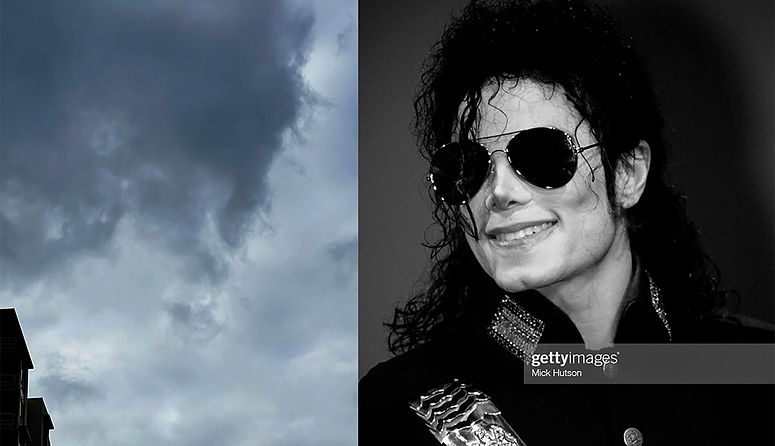
All of the thoughts about life will be put in this first column of Life as Cloud. The cloud images shown here were all taken by myself in the past three years. They are profound and breathtaking.
CHAPTER II
I Know That I May Not Know
Psychoanalysis is not only a treasure of Western civilization, but also the greatest contribution from the west to the spiritual civilization of mankind. Among dozens of books authored by Erich Fromm, four of them represent the pinnacle in this field - namely the Art of Loving, Psychoanalysis and Religion, Psychoanalysis and Zen Buddhism, the Anatomy of Human Destructiveness.

Our wills, no matter how sincere we think they are, are likely to be expressions of repressed unconscious energy. The desire to go to heaven may just be compelled by our fear of death. Just as the Sutra of Forty-two Chapters says: – “Rely not upon your own will. Your own
will is not trustworthy” and “Your own will becomes trustworthy only when you have attained Arhatship.” In Buddhism, an arhat (Sanskrit: अर्हत्) or arahant (Pali: अरहन्त) is one who has gained insight into the true nature of existence and has achieved nirvana.
Both the Christian heaven and the Buddhist concept of reincarnation are true, but we can’t think of going to heaven and enjoy an everlasting life only in isolation. What is more pertinent is to think about whether we have the capacity to handle everlasting life. After all, even a few decades are thought by many of us as too long to bear and sadly many want to end life much sooner.
Tai Situpa Rinpoche said in his book Ground, Path & Fruition that “We all enjoy life, but at a certain point we have had enough of it. At a certain point we would not mind a new beginning, a new start. We would not mind going to kindergarten again – it may even be interesting.”.
Maybe death is a gift from God to us, so that those of us who can’t bear everlasting life can live period by period, an intermission so to speak. Just as the 17th Karmapa puts it: A SHORT VERSION OF A LONG LIFE.
Perhaps this is similar to how great images are distinguished by the interplaying contrast of light and darkness. It could be the actual intention of God to use death as the background to life. It seems
that without the background of death, it would be difficult for many of us to really appreciate the value of life. It can be impossible for us to cherish anything that we can never lose or was too easily won.
Life is sacred. The intention and action of one life to possess and control another is the real original sin.
The meaning of life lies in freedom. In addition to the ability to endure immortality, we should also consider to what extent we are alive. As long as we are still driven by unconscious forces, we are not free. Unfortunately to what extent we are not free, to that proportion we are not alive.

Our consciousness has a self-defense mechanism to block unpleasant information, a process defined as repression in psychological term. Repressed information is not gone at all. It persists in our unconscious, silently and constantly exerting influence on our consciousness and manifesting in dreams, guilts, fears and hopes.
Bringing unconsciousness into consciousness is awakening and liberating.

The psychiatrist helped him recollect this traumatic experience and help him to know that it was an accident, not his fault. Facing the experience was extremely painful, but the patient’s symptoms disappeared.
Freud’s contribution is indelible. He found that our psychological forces determine our behavior, and most of these forces are unconscious; perceiving these forces will change their load and direction.
In Fromm’s words, “Freud’s own system transcended the concept of illness and cure and was concerned with the salvation of man, rather than a therapy for mentally sick patients. His aim was the domination of irrational and unconscious passions by reason; the liberation of man from the power of the unconscious, within the possibilities of man. “
Freud believed that reason is the only power of human beings. Only it can save human beings from chaos and suffering. It was true pioneering for Freud to divide the psychic apparatus into three portions: “Id”, “Ego” and “Superego”. As Freud said the therapeutic efforts of psychoanalysis are intended to strengthen the “Ego”, to make it more independent from the “Super-Ego”, to enlarge its field of observation, so that it can appropriate for itself new parts of Id”. “Where there was Id, there shall be Ego.”
How powerful can our unconscious be? Let’s explore one example. A patient suffered from long and repetitive and ritualized obsessive compulsive hand washing. It was difficult for him to stop even when his relentless scrubbing brought
“Id”, “Ego” and “Superego” could be seen as trinity in psychology. The Trinity can be more pertinent to us than the trinity of the Holy Father, Holy Son and the Holy Spirit. Whenever we find ourselves compelled to do things inexplicably, we are likely driven by unconscious forces. It is our task to enhance the Ego, to unify with the irrational Superego, and to occupy the territory of the unconscious Id. The pain and entanglement of “ego” mostly comes from the conflict with the irrational “Superego” and the unconscious “Id”. If our “Ego” can fully expand itself and realize just like that “I ALONE AM THE WORLD HONORED ONE” as declared by Shakyamuni, in the small universe of Ego-Superego-Id, it could be a huge achievement. God cannot have unconscious – and thus is true omniscience.
him to the point of bleeding. The worst part was that he did not know why he did this. Through dream interpretation, free association and analysis of the patient’s unconscious behaviors, the psychiatrist pieced together a story. The patient had an accident in his early childhood. While he was playing by the pool, his brother fell into the pool and was drowned. He completely “forgot” about the incident, or to put it in psychological terms, he repressed this traumatic experience entirely into his unconscious. Washing his hands became a compulsive ritual to help him purify his sense of guilt.
CHAPTER III
I Am The Truth
I am the truth. These are the most profound and most misunderstood words that Jesus ever
spoke. Most Christians understand ‘the truth’ as a story: Jesus redeemed the sins of
all believers with his own sufferings, and as long as they follow him, they shall be able to return to the kingdom of heaven.

But if that is so, Jesus would have said, “I know the truth,” rather than “I am the truth.” You can only know a story, but you cannot be a story. The difference between “I know the truth” and “I am the truth” is so immense. I would assume that no one could understand what Jesus really means unless he/she can say that “I am the truth” himself/herself.
I also assume that God is able to declare “I am the truth” as well. I’ve shared these ideas with some Christian priests, and they don’t seem to object.
Truth is not a statement, but an existential realization which transcends ideology.
“I am the Truth” directly equates “I” and “Truth”,
concepts from two different dimensions, impeccably comparable to the statement of “Form is emptiness” from the Heart Sutra.
I have read more than a dozen interpretations of the Diamond Sutra. The best are “Buddha Speaks Mahayana On Diamond Sutra” and “On Diamond Sutra” by master Sheng Yi, who is regarded as the spiritual successor of Sakyamuni Buddha. Buddha Speaks Mahayana On Diamond Sutra is an inquiry on complex aspects of the Diamond Sutra carried out by Manjusri Bodhisattva to the Buddha on our behalf. His words are as accurate as Buddhist sutras. There is not much question that this book ranks as second place. It would not be too much to say that these two books surpass What Diamond Sutra is About written by Mr Huaijin Nan by a wide margin.
The highest form of existence of gods is light. So as I heard from a master.
We may always think that we should go towards the light, but maybe just as a song says, we may have to go against the light to break through the darkness. God could be at the end of the darkness.
We cannot expect to complete this journey overnight. Chögyam Trungpa rinpoche said: we have to wear the shoes of samsara and walk our way through meditation until we wear out the shoes.

CHAPTER IV
Step Into Two Rivers Once
Heraclitus is a great ancient Greek philosopher who said “Change is the only constant”, more than1000 years before the most prominent Chinese Zen master the sixth patriarch Hui Neng said, “Impermanence is constant.”
Heraclitus must have seen the value of innocence in children. We see evidence with his statement that “The adult citizens of Ephesus should hang themselves, every one, and leave the city to children”. He saw the problems that the people caused, but did not find the solution.
Jesus had a much deeper insight when he said “Truly I say to you, unless you are converted and become like little children, you shall not enter the kingdom of heaven.” This is the answer, the Way.
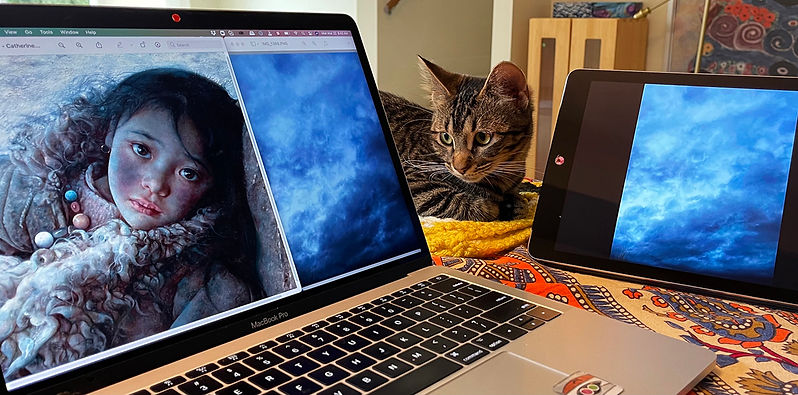
What Jesus said is to us adults, hoping that we can achieve a transformation from adults to children. The higher value lies in the adults who have realized the transformation. Otherwise, can it be simple to have the children directly born in heaven?
We need to be aware of the difference between us and children. In the process of reaching adulthood, what has been lost? What kind of burden have we accumulated rendering us incapable of going back to heaven?
We must have lost our innocence. We have also set out many unnecessary conditions for happiness, and thus created an environment well suited to suffering.
Through the transformation from an adult to a child, a higher level of innocence is achieved.
The higher lever of innocence means that: we can still benefit from the speculative system of logic and concepts, but without losing connection with the nature of life which is beyond language.
Our burden is largely a frame of reference. We need a frame of reference to answer the fundamental questions of life: who am I, where do I come from, where am I now, and where do I go?
In Fromm’s words: “man needs a map, a frame of orientation... or he would have no way of orienting himself… so his world makes sense to him, and he feels certain about his ideas through the consensus with those around him. Even if the map is wrong, it fulfills its psychological function.”

Most Buddhists are not actually interested in becoming Buddhas, but instead are more interested in being Buddhists. This serves as an eternal journey, while you always have a goal to strive after, always have something to work with, always feel replenished, the uttermost importance is that it provides a definition of the ego.
The question is whether we can transcend all answers, purposes, language, concepts, self-definition, frame of reference, frame of orientation, and not lose contact with that innate innocence we had as children.
Transcending these is to fundamentally transcend fear, expectation, possession and control.
Life is sacred. The intention and action of one life to possess
and control another is the original sin.
Transcending these is the only way to transcend the flow
of karma.
A student asked the philosopher Bertrand Russell what is the meaning of life. Russell asked back: “why do you want to know the meaning of life?”. Russell is right. We all need to ask ourselves whether we can live happily in the absence of answers to the fundamental questions of life? There are thousands of answers to the meaning of life, and these answers have imposed immeasurable and meaningless sufferings to human beings.
Another famous saying of Heraclitus is: “one cannot step into the same river twice”, a phase that carries the style of quantum physics.
Time may not flow as contiguously as we think. It is more like light, works in wave-particle duality. Every ksana (split second) in time may exist both by itself and simultaneously.
“One cannot step into the same river twice” only revealed the problem, but not the answer. Human civilization has advanced for more than 2500 years. We shall be courageous enough to say that “one can step into two rivers at the same time.”.

The two rivers we step into are Meditation and Philosophy.
The most extreme method of meditation is to go through a lengthy retreat in strict enclosure to exhaust all concepts and cerebration, leaving behind a void without ideology. However, the emptiness obtained after three years of seclusion is fragile if without support from a strong philosophy. it is just like the innocence of a child which can be easily lost.
Only when fortified by philosophy, will innocence have the capability to effect everlasting life.
All concepts can be summed up as “everythingness” and “nothingess”. Buddhist philosophy is more inclined to the approach through “nothingness”, Christian philosophy is more inclined to the approach through “everythingness”, while Taoist philosophy is inclined to the unity of and inter-transformation between “everythingness” and “nothingness”. As Tao Te Ching says, “Therefore everythingness and nothingness give birth to each other. Difficult and easy accomplish each other. Long and short form each other. High and low distinguish each other.
Sound and tone harmonize each other. Before and after follow each other as a sequence.”
The “nothingness” in Buddhism is a double negation which can be interpreted as neither “everythingness” nor “nothingness”. This neither ‘this’ nor ‘that’ is too abstract. It is not easy to interpret and accept something that cannot be grasped in nature.
The philosophy of Taoism is a double affirmation. It is both “everythingness” and “nothingness.”

The double negation of the concept of nothingness in Buddhism can be described with one Chinese word “無” which means “nothingness”, but not with only one word of “空” which means “emptiness”. At least two characters of “空” are needed to describe “nothingness.” That is why a Taoist priest in the book Dream of the Red Chamber (Honglou Meng) called himself “空空道人”— “Empty-Empty Taoist.” If you are only allowed to use one word of “空,” you will have to say “毕竟空”—“absolute emptiness” (atyantaśūnyatā).
“All dharmas are marked with emptiness” in Xuanzang (Hsüan-tsang) and Kumārajīva’s of the Heart Sutra is not an accurate translation. The “all dharmas are empty in nature and devoid of characteristics” in the Dunhuang version and in the Ninth Gangkar Lama’s translation are more in line with what Buddha meant.
Xuanzang’s and Kumārajīva’s versions of the Heart Sutra contain “no wisdom, no attainment”, while Dunhuang’s longer version and the Ninth Gangkar Lama’s translation from a Tibetan version contains “no wisdom, no attainment, no non-attainment”. The double negation of Buddhism is not complete without adding “no non-attainment”.

I arrived at a modified recension by making the best out of the four versions mentioned above based on Xuanzang version. The recension corrected the mistakes, and still retains the unrivalled beauty of Xuanzang’s style of diction. It is a quintessence of both Chinese and Tibetan Buddhist master’s work.
The “everythingness” is emphasized in Christianity through the concept of trinity. The best interpretation of trinity can be found in the book of Conversation with God which says the following:
-
In the absolute there is no experience, only knowing. Knowing is a divine state, yet the grandest joy is in being. Being is achieved only after experience. The evolution is this: knowing, experiencing, being. This is the Holy Trinity—the Triune that is God.
-
God the Father is knowing—the parent of all understandings, the begetter of all experience, for you cannot experience that which you do not know.
-
God the Son is experiencing—the embodiment, the acting out, of all that the Father knows of Itself, for you cannot be that which you have not experienced.

-
God the Holy Spirit is being—the disembodiment of all that the Son has experienced of Itself; the simple, exquisite is-ness possible only through the memory of the knowing and experiencing.
-
Your mind can best hold the relationship as: parent-offspring. Or: that-which-gives-rise-to, and that-which-is-risen. Adding the third part of the Trinity produces this relationship: That which gives rise to / That which is risen / That which is. This Triune Reality is God’s signature. It is the divine pattern. The three-in-one is everywhere found in the realms of the sublime. You cannot escape it in matters dealing with time and space, God and consciousness, or any of the subtle relationships. On the other hand, you will not find the Triune Truth in any of life’s gross relationships…
The world is a multi-dimensional reincarnated system created by God by way of simulation.
We can see that a subtle trace of fear across the face of Elon Musk when he said at Recode’s Code Conference that the “the odds that we are in base reality is one in billions”. He must have felt the power behind what is capable of simulating our world.
Whether this power comes from an individual, a group, or a higher civilization, the capability of this entity is sufficient that we can call it God.

Depicted in motion picture, we have an unprecedented film “the Matrix.” This film interprets simulation, philosophies and religions both oriental and occidental with powerful visuals, showing these concepts with surreal profundity. In the film, the character Neo has a book in which he hides a computer disk. The book is Jean Baudrillard’s Simulacra and Simulation. All of the actors were made to study philosophy for six months and read Simulacra and Simulation before filming began.

Simulacra and Simulation tells a very interesting story whereby “the cartographers of an Empire draw up a map so detailed that it ends up covering the territory exactly”. Until “the decline of the Empire witnesses the fraying of this map, little by little, and it fall into ruins…rotting lie a carcass, returning to the substance of the soil, a bit as the double ends by being confused with the real through aging.”
The map in this fable represents conceptuality.
We use concepts to define and interpret everything. It spreads over all territory of the mind, completely covering up the primordial heart.
Concepts, logic and language have practicality, but remain secondary. The heart which is beyond concept, logic and language is primordial. It’s both a blessing and a curse to have a complex system of language and contemplation. Completely getting lost in what is secondary, and loosing contact with the primordial is not worth the loss. That is exactly how we lost reality.
Not losing contact with the primordial in every kṣaṇa (split second) is enlightenment.
We also have a lot of misunderstandings about Buddhism. We seem to understand Buddhism as being pacified and devoid of desires, and staying afar from the secular world with the ultimate purpose of transcending reincarnation. In fact, the real problems Buddhism are dealing with are: Who we really are? Are we ultimately free?
Freedom is deeper than pleasure.
The highest principle of the heart is that one can go out to play without losing the way home. Once one loses the way home, the heart will be unrest.

Master Hui Ke, the second patriarch of Zen, after standing in the snow outside of Bodhidharma’s cave and losing an arm, asked the master “My heart is unrest. Please pacify it.” Bodhidharma replied, “show me your heart, and I will pacify it for you.” Huike said, “Although I’ve sought it, I cannot find it.” “There,” Bodhidharma replied, “I have pacified your heart.”
Our heart is always like a newborn baby, beyond conceptuality. How could Hui Ke convey his heart to Bodhidharma through words?
Language is a bunch of concepts woven together by logic, while the heart is in a different dimension.
Heart is sacred, language is secular, neither can be dispensed with. Is there really anyone who can be absolutely otherworldly?
The heart is very much like the chip in a computer or a cell phone. The language and logic speculation are more like the operating system. One is noumenon, the other is function.
When Master Hui Neng (the sixth Patriarch) arrived at the fifth patriarch’s temple, he had already realized the empty nature of the noumenon of the heart, so as he expressed in his famous verse “By origin there is not a single thing, where could dust arise?”. Hui Neng was later summoned to the mediation room of the fifth patriarch to listen to his explanation on the Diamond Sutra. When Hui Neng heard that “one should give rise to a mind which does not dwell in anything”, he was fully enlightened at the time and said, “did not expect one’s own nature could give rise to all dharmas.”.
“無為”(Non-action) of Taoism corresponds to noumenon and “無不為”(leaving nothing undone) corresponds to function. “Noumenon” and “function” are two different dimensions of existence, but still are unified.
This nature of the heart resembles a computer chip which is thoughtless. Because it is thoughtless, we tend to ignore and forget about its value and get ourselves lost in the operating system in which we believe that’s where real values dwell. In that way, an artificial manmade reality replaced the ultimate reality.
Buddhism is to tell us that the heart which is beyond thoughts is

awaken in nature. Losing contact with the heart, we will feel unrested. This unrest is unconscious and the root of all anxiety, anger and sufferings. It is the fundamental ignorance.
Does your better half always want to initiate a fight with you? The energy behind that is the unconscious unrest.
The cassock and alms bowl of Sakyamuni Buddha was handed down to Zen Buddhism not without a reason. The mentle of his holiness was not passed on casually.
“How to pacify the heart” is Hui Ke’s first and ultimate question after kneeling in the snow for three days. The first question that Subhuti asked in the Diamond Sutra is also: “when good man and good women wish to attain Anuttara Samyaksambodhi (unexcelled supreme enlightenment), how should their minds dwell? How should they pacify their minds?” He asked the same question twice in Diamond Sutra.
In our spiritual journey seeking truth, we may always have an underlining misunderstanding, that is, “this place” where we stay is wrong, and as long as we go to “that place” the problem will be solved. “That place” is presented as the legendary kingdom of heaven, or Sukhāvatī (the Western Pure Land) in Buddhism.

In fact, no matter ‘where’ we are, we are all ‘here’. As soon as you get to “there”, ’there‘ immediately transforms into ‘here’. The question of how our minds should dwell and how should we pacify our minds still has to be faced with no matter where we are. We can only deal with this at the individual level- for ourselves. No one can do it on our behalf. The unconscious energy fueling our quest for heaven can be the attempt to shake off the exact responsibility that we have to undertake no matter what.
We can delay this issue indefinitely, but it will remain unsolved. There is no shortcut.
What we need to do is to unify the primary noumenon of the heart with the secondary language and contemplation system. When Master Hui Neng first met the
fifth patriarch, he said “constantly keeping our mind inseparable from one’s self nature, by itself is the field of blessing”. Both the remark of Hui Neng and Trungpa Rinpoche’s “Touch and Go” are referring to a call from the secondary functionality to the primordial nature. The “whatever put in words and speech, there is no real meaning” from Surrangama Sutra is the light from the primordial nature penetrating the secondary functionality. It is a transcendental perception of the primordial nature on the secondary functionality. From the perspective of the secondary functionality, it must be that “whatever put in words and speech, there is real meaning”, it cannot be “whatever put in words and speech, there is no real meaning” otherwise, why we say things. Both perceptions are correct, only the angle and perspective are different.

Civilization is a type of operating system that should be updated continuously. Ultimately, the backwardness of a civilization is a result of the backwardness in philosophy. If the School of Legalism of China (200 - 300 BC) did not lose the battle against Confucianism, not to mention how powerful China could be, the backwardness of China's modern times would certainly have been avoided.
The God who can easily create a multi-space-time universe has infinite wisdom and love, transcending all possible human weaknesses. He can never possibly be a jealous, narrow-minded, irritable, and revengeful God who prefers
‘believers’ over ‘non-believers’. This is stated clearly in Bible as “God so loved the world”, instead of “God so loved his believers.”
Every human life is a child of God. The distance between all children and God is exactly the same as the distance between Jesus and God. The distance is constant, like the speed of light, and there is no way to change it by any artificial means.

God’s plan is perfect. If we think it is not, it is because of our lack of wisdom and information. Our prayers are largely attempts to make proposals to God to change his plans.

Truth is an existential realization kṣaṇa by kṣaṇa, and each kṣaṇa is independent. I would prefer to put my hand on both the Bible and Conversation with God at the same time to swear.
The only prayer I can think of is: May I, just like the Lord Jesus, declare at every moment that “I am the truth.” This can be everyone’s prayer.
All honor and glory to God forever and ever! ! !

EXPLANATION OF TERMS
Sutra (San.): The hinayana and mahayana texts in the Buddhist canon that are attributed to Shakyamuni Buddha; the teaching often takes the form of a dialogue between the Buddha and one or more of his disciples.
Heart: The essence or key point. Because this sutra is one of the shortest and pithy expositions of prajnaparamita, it is referred to as the “heart.”
Transcendent knowledge (San. prajna-paramita; “perfection of knowledge” or “knowledge gone to the other shore”): The highest kind of prajna, which sees the nature of shunyata. Paramita means “gone to the other shore”; that is, having transcended samsara and attained nirvana.
Shunyata (San. “emptiness”): Shunyata is the principal theme of the sutra. Shunyata mean emptiness of any inherent existence or solid reality, either in oneself or in phenomena. It is an awareness that apparent phenomena are without origination or basis; it is freedom from conceptuality. In particular, it is the realization of threefold purity: that there is no “I” as actor, no action, and no “other” to be acted upon. It is very important to understand that shunyata is not the nihilistic idea of nothing, or voidness. As the sutra says, it is inseparable from the appearance of perceived objects such as forms.
Avalokiteshvara: The bodhisattva of compassion. Through his own great power of meditation, the Buddha causes a profound realization of the nature of reality in Avalokiteshvara, who then becomes his spokesman for presenting the teachings on shunyata.
Dharmas: In this context, dharmas refer to phenomena, rather than to the Buddha’s teachings.
Characteristics: Any name or label or description that could be attached to a thing; any qualities perceived with fixation.
Mantra (San. “mind protection,” according to the Tibetan tradition): Sanskrit words or syllables that express the quintessence of various energies, whether or not they have conceptual content as words. In vajrayana, mantra is explained as that which protects the vajra mind, the indestructibly awake nature of mind.
OM GATE GATE PARAGATE PARASAMGATE BODHI SVAHA: This Sanskrit mantra represents the quintessence of the sutra beyond concept. It means: “OM gone, gone, gone beyond, completely gone beyond, awake, so be it.”
Tathagatas (San. “ones thus gone”): An epithet of the buddhas, or fully awakened ones, who have “gone to the other shore in this very way.” Those who have journeyed on the same path as all the enlightened ones and reached the goal: freedom from the two obscurations of conflicting emotions and mistaken views about reality.

AFTERWORD
WE SHALL BE AS LIGHT
The book is intended for both believers and non-believers who are of exactly the same value to me as readers. I have no intention to convince anyone to relinquish their current position, but to expand to be more inclusive.
Before providing the manuscript to the publisher, I shared it with my friends seeking advice and comments. Other than compliments, there have been intensive discussions which can be summarized in three categories:
1. From non-believers: I don’t believe in religion, why should I be bothered with anything that I don’t believe. Neither Buddhism nor Christianity makes sense to me. Buddha is self-contradictory by alleging that he has found nothing in his inner search but still has a lot to tell us. Christianity too by presenting a loving God who also created an eternal burning hell for all non-believers. Philosophy is only an ideology, and is not broad enough to incorporate religion and psychology as the lord of the ring.
2. From believers: I have found my religion, a perfect one that provides all kinds of answers, promises, and above all, certainty. Why should I be bothered to learn about other religions and philosophies.
3. What on earth is the philosophy that you are talking about?
The main difference between believers and non-believers lies in the question over whether there is life after death. I would assume that no one can be absolutely certain until he/she eventually dies. It does not hurt much to be theoretically prepared, or at least psychologically prepared for the surprise.
The difficulty in Christianity is insurmountable. There has been human manipulation of the Bible over a thousand years rendering the Bible defenseless in many ways. There is no way for the Bible to survive the scrutiny of someone like Friedrich Nietzsche, or lawyers. But, I would recommend anyone who challenges the authority of Bible to instead challenge Conversation with God. I believe the messages are from God and the book is an upgrade of the Bible inspired by God himself. I am ready to defend the whole series paragraph by paragraph, line by line and word by word.
The difficulty in Buddhism is different. To be able to understand Buddha’s message, one has to go beyond logic because life is beyond logic in essence. Further explanation is hardly possible without first quoting what Fromm said as follows in Psychoanalysis and Zen Buddhism:
-
The question then, is to understand more concretely how this “social filter” operates, and how it happens that it permits certain experiences to be filtered through, while others are stopped from entering awareness.
-
A good example of this is the difference between Aristotelian and paradoxical logic. Aristotelian logic is based on the law of identity which states that A is A, the law of contradiction (A is not non-A), and the law of the excluded middle (A cannot be A and non-A, neither A nor non-A): Aristotle stated it: “It is impossible for the same thing at the same time to belong and not to belong to the same thing and in the same respect. … This, then, is the most certain of all principles.”
-
In opposition to Aristotelian logic is what one might call paradoxical logic, which assumes that A and non-A do not exclude each other as predicates of X. Paradoxical logic was predominant in Chinese and Indian thinking, in Heraclitus’ philosophy, and then again under the name of dialectics in the thought of Hegel and Marx. The general principle of paradoxical logic has been clearly described in general terms by Lao-Tse: “Words that are strictly true seem to be paradoxical.” And by Chuang-Tzu: “That which is one is one. That which is not-one, is also one.”

Socrates has allegedly said something similar as “I Know That I Know Nothing”. Nietzsche also said or quoted: “One remains a philosopher only because one says – nothing! ”
Bertrand Russell’s definition of philosophy seems very interesting. As he wrote in his book the History of Western Philosophy that: “All definite knowledge – so I should contend – belongs to science; all dogmas as to what surpasses definite knowledge belongs to theology. But between theology and science there is a No Man’s Land, exposed to attack from both sides, and this No Man’s Land is philosophy”.
Philosophy is much larger than ideology. It is more a general perception of everything.

What I am trying to present is a philosophy being able to handle both religion and science, and anything in between. As I put it in the foreword, no one can set a boundary marking down how far philosophy can go. If I am right about philosophy to whatever extend, then it is something that we can work with, something more realistic than handling or utilizing God as a concept to accomplish personal projections. This mentality is not uncommon in many religions.
The question of what life really is, and whether we live in reality or a simulation shall certainly be covered by philosophy. If by any chance we do live in a simulation, we will then have to figure out the laws that govern the simulation, the relationship between free will and determinism, the system of karma, etc. Of course, it is also your free will to deny this and go back to your normal life.
Neale Donald Walsch, the author of Conversation with God, said in an interview that his new book the Only Thing That Matters “argues for the combining of the mind and soul in the consideration of our daily choices and decisions. Our mind holds nothing but experience, but the true knowledge is held in the soul, eternal wisdom is held in the soul, so our job as human beings is to find a way to marry the mind’s experience and the soul’s knowledge, and to come to a place in between. When a person does that, they are said to have been centered … all of the great mystics have found that place. They don’t just reject the mind altogether, because the mind’s experience is valuable…My mind is a good friend. All the true mystics and masters have found a way to marry the mind and the soul other than live exclusively in the mind to the exclusion of the soul. If I had one piece of advice to for human beings it would be to connect with your soul.”
When asked how he recommends people connect, Neale replied “There are a thousand ways to do that, meditation…visualization, ecstatic dance… reading good poetry, praying, you know there are a thousand ways.”
I have no problem with what he said in there, but in terms of how to connect, my recommendation is via philosophy, which could serve as

a sword of wisdom cutting through illusions---an approach more specific and workable. The answer of mediation, visualization, ecstatic dance, reading good poetry and praying is beautiful but too broad and vague. They are not wrong, but you hardly have any clue still, unless you are already a mystic.
The philosophy that I am presenting in this book is very much like a pyramid, with Buddhism, Christianity, Taoism and Psychoanalysis as the four facades, and with philosophy as the foundation uniting the four facades.

It can also be seen as the three pyramids with philosophy as the great pyramid Khufu, the other two as psychoanalysis and religion.
Neither Buddhism nor Christianity are balanced in their teaching. One is overly focused on egolessness, and the other overly focused on belittling the ego.
If I had one phrase to summarize the philosophy that I am presenting here it would be Fusion of the Opposites.
Life shall be as light.

We need both opposites to wave, to vibrate, the ultimate form of existence. The vibration is the ultimate dance between everythingness and nothingness, ego and egolessness, language and silence, form and emptiness, individualism and collectivism, fear and fearlessness, certainty and uncertainty, sacred and secular, theism and atheism, real and unreal.
Truth is fusion of the opposites. The way of fusion is to equalize the opposites. This is the Way, the ultimate form of Life. “I am the truth” is a Fusion of ‘I’ and ‘the truth’. Same applies to ego and egolessness, everythingness and nothingness, real and unreal, etc.
The fusion of the opposites can be expressed mathematically as 1 = 0.

It is the only way to transparentize our ever increasingly heavy stream of consciousness.

A friend who is a university professor reminded me that it is better to use the term of ‘Preface’ instead of ‘Foreword’ as ‘foreword’ is written by someone other than the author while ‘preface’ is written by the author himself. When I looked further into the matter, I found out that it was such a beautiful mistake that I would rather keep than abandon. What I was trying to say in my response to the professor is that it is not about right or wrong, it is about freeing our mind.
The Heart Sutra is ended with a mantra: “in the Perfection of Wisdom the mantra has been uttered in this way: Gate Gate Paragate Parasamgate Bodhi Svaha” which means: Gone, gone, gone beyond, completely gone beyond, so be it!
The best way to achieve ultimate fusion is to go beyond whatever ideology that you hold now and whatever ideology that you may arrive at down the road forever and ever.

A lot of gratitude goes to Francis Lamer, Qing Yan and Dallas La Porta. Their penetrating minds contributed greatly to the ideas discussed in this book. Special thanks goes to Dallas asl well. As a sophisticated native speaker, he improved the English of the manuscript.
I can’t express enough on how much I owe to my Mom who set up very good foundations in my heart since my early childhood in arts, music, literature, poetry, and methodology.
Special thanks go to all of my Buddhist and Taoist masters, and all of the friends who offered me help when most needed, especially Lijuan Wang.
Below is the email response to the professor friend mentioned above who prefers to remain anonymous.
Dear Professor,
Thank you for your comments which is very valuable to me!
When I chose the word ‘Foreword’, I flipped open one of Fromm’s books in front of me randomly to be sure that I was using the right term. When I received your email, I went back to his books and found he did use the same word for most of his books, except one, as far as I know. This became very interesting to me.


I checked other books, and found C. G. Jung also used ‘Foreword’ for his books.

But not Nietzsche. He is accurate as always.

To assume that Fromm and Jung do not know the difference between the two terms is unthinkable, nor the translators as some of their works have been written in German. Fromm wrote in English after he moved to the U.S. The only book that he used ‘Preface’, as far as I know, is the Anatomy of Human Destructiveness, his most important work from my point of view. Was he feeling more as an author for that particular book?

Freud uses both ‘Introduction’ and ‘Preface’.

One possible assumption is that Fromm and Jung purposefully used ‘Foreword’ to convey a deep thinking that “I am not myself”.
My humble book is also very much about the definition of Ego.
“I am what I am” (Exodus 3:14) is so existential, defying any definition. “I am What I am not” from Conversation with God explicated “I am what I am” much further. The thinking is bounced back to me. To what extend that I am comfortable calling myself author of my book.
The cloud images are certainly not my work. The same dream came back to me over and over for a while that I saw huge 3D images in the cloud and rushed out my cellphone to take pictures, and when I looked back I saw someone projecting those images onto the cloud with a projector. I felt so real in the dreams that I was fooled.
I sometimes saw the images of the cloud in my dreams one day before I took them in real life. There have been constant conversations via telepathy between me and the ‘unknown’ over the images among all other things. The pictures that I put in the manuscript are only a small portion.
Even the philosophies covered in this book can be traced back to all different cultures since we have existed as human.
So, what did I do?
I put them together. Does that entitle me to be called ‘author’?
If Fromm and Jung intentionally used ‘Foreword’ to expand the definition of Ego, could it be that Xuanzang (Hsüan-tsang) and Kumārajīva intentionally overlooked such an important term of “no non-attainment” while translating the Heart Sutra from Sanskrit. They are not that bad at all to overlook that phrase.
If Xuanzang (Hsüan-tsang) and Kumārajīva intentionally overlooked ‘non-attainment’ for someone, like me in this case, to put it back 1500 years later, then who is the author of the arrangement?
Shall I keep ‘Foreword’ as a beautiful mistake?
The revised sutra is attached for your reference. I believe it was not included in the version that I sent you as the translation was not done yet at the time. Anything underlined is what I added to the Xuanzang version.
Best regards,
Fan


HEART SUTRA
བཅོམ་ལྡན་འདས་མ་ཤེས་རབ་ཀྱི་ཕ་རོལ་ཏུ་ཕྱིན་པའི་སྙིང་པོ
Bodhisattva Avalokiteśvara, when practicing profound Prajñāpāramitā, saw through illuminating that the five skandhas to be empty of nature, thus crossed beyond all suffering and misery.
Shariputra, form is emptiness (śūnyatā); emptiness also is form; non-form differs from emptiness; non-emptiness differs from form; emptiness does not differ from form; form does not differ from emptiness. In the same way, feeling, perception, formation, and consciousness are emptiness. Thus, Shariputra, all dharmas are empty of nature and devoid of characteristics. There is no birth and no cessation. There is no impurity and no purity. There is no decrease and no increase. The dharma of emptiness transcends the nature of time. Therefore, Shariputra, in emptiness, there is no form, no feeling, no perception, no formation, no consciousness; no eye, no ear, no nose, no tongue, no body, no mind; no appearance, no sound, no smell, no taste, no touch, no dharmas; no eye dhatu up to no mind dhatu, no dhatu of dharmas, no mind consciousness dhatu; no ignorance, no end of ignorance up to no old age and death, no end of old age and death; no suffering, no origin of suffering, no cessation of suffering, no path, no wisdom, no attainment, and no non-attainment.
Therefore, Shariputra, since the bodhisattvas have no attainment, they abide by means of Prajñāpāramitā. Since there is no obscuration of mind, there is no fear. They transcend falsity and attain complete nirvana. All the buddhas of the three times, by means of Prajñāpāramitā, fully awaken to unsurpassable, true, complete enlightenment, fulfilling the Buddha way.
Therefore, the great mantra of prajnaparamita, the mantra of great insight, the unsurpassed mantra, the unequaled mantra, the mantra that calms all suffering, should be known as truth, since there is no deception. The Prajñāpāramitā mantra is said in this way:
DAYATA OM GATE GATE PARAGATE PARASAIGATE BODHI SVAHA
Shariputra, the bodhisattva mahasattva should train in the profound prajnaparamita thusly.